If you’ve ever stood inside a substation on a hot summer day, when transformers hum and lines crackle with hundreds of thousands of volts, you’ve been near one of the most unsung workhorses of the power grid: the high-voltage circuit breaker. To most people, this boxy piece of steel and porcelain is just another piece of grid infrastructure, but for anyone who works with power distribution, it’s the safety valve that keeps the lights on. I’ve spent 12 years working in this industry, first as an engineer testing breakers in a lab, and now as part of a team that designs, manufactures, and supplies high-voltage circuit breakers for utilities across the globe. One question comes up again and again from new clients and even young engineers just starting out: What makes these breakers so good at stopping the huge, dangerous sparks that happen when a circuit needs to shut off? Put simply, it’s arc quenching, and it’s a mix of physics, engineering, and materials science that we’ve refined over decades to keep power systems safe and reliable. High-voltage Circuit Breaker
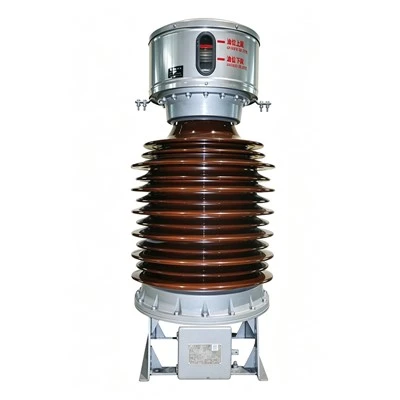
First, let’s break down what that arc actually is, because if you don’t understand the problem, you can’t solve it. When a high-voltage circuit breaker is open, there’s a small gap between its two contacts. The power grid sends current through those contacts to run homes, factories, and hospitals. When the breaker gets a signal to trip—say, a fault is detected by a relay, or routine maintenance is needed—it has to pull those contacts apart quickly. But at 110 kV, 220 kV, or even 550 kV, the voltage is so high that it doesn’t just stop when the contacts separate. The electric field is strong enough to pull electrons off the air molecules between the contacts, turning the gap into a plasma arc: a hot, bright, conductive channel that carries thousands of amps of current. That arc isn’t like a match flame; it’s 10,000 degrees Celsius, hotter than the surface of the sun, and it releases a massive amount of energy. If that arc isn’t extinguished fast, it can burn through the breaker’s internal parts, cause a catastrophic explosion, or even reignite and keep the fault running, leading to widespread blackouts. I still remember my first day on the job in the lab, when a trainee left a breaker’s test chamber open during a fault test and we watched an arc cut a 2-inch hole through a steel panel. That moment drove home just how critical arc quenching is.
The core of arc quenching is breaking that conductive plasma channel. To do that, we rely on three basic physical principles, and most modern high-voltage breakers use at least one, often a combination, of these methods to kill the arc. The first and most common method is pressure-driven gas blast, which is what we use for the majority of our medium and high-voltage breakers now, especially for transmission grids. Let’s walk through how that works inside a typical puffer-type circuit breaker, the design that’s been standard for 40 years. Inside the breaker’s housing, there’s a moving contact and a fixed contact, surrounded by a chamber filled with sulfur hexafluoride (SF6) gas—for decades the go-to gas for this, though we’ve been developing alternatives in recent years for clients focused on sustainability. When the breaker trips, a mechanical linkage pulls the moving contact away from the fixed contact. This movement also compresses a volume of the gas inside the puffer cylinder, creating high pressure—up to 10 times atmospheric pressure—behind the arc. As the arc forms between the separating contacts, this high-pressure gas is forced through a nozzle directly at the arc. The gas does two key things here: first, it blows away the hot plasma particles, cooling the arc to the point where the ions and electrons recombine into neutral gas molecules, which stops conductivity. Second, it resets the gap between the contacts by replacing the hot conductive plasma with cold, insulating gas, so that when the current passes its zero point every half-cycle (AC current alternates, so it hits zero 100 or 120 times a second, depending on the grid frequency), there’s no remaining conductive path for the arc to reignite. That last part is crucial: even if we cool the arc, if the gap isn’t insulated enough, the voltage will jump in fast enough to reignite the arc before it can fully stop. That’s why the puffer system has to work in milliseconds—usually less than 20 milliseconds for a high-voltage breaker, so faster than the blink of an eye.
Another method we use is the self-blast, or complementary, design, which is great for higher voltage breakers because it doesn’t need as much mechanical force to generate the gas pressure. In a self-blast breaker, instead of compressing gas with the contact movement, we use the energy of the arc itself to heat the gas and build pressure. When the arc forms, it burns through a small amount of the PTFE (Teflon) nozzle material at the contact tip, creating a burst of gas that expands into the chamber, building pressure to blow out the arc. This method reduces the size and weight of the breaker’s operating mechanism, which is a big benefit for substations where space is at a premium. I worked on a self-blast breaker project a few years ago for a utility in the Pacific Northwest that needed to upgrade an old substation built in the 1970s; the old puffer breakers were too big to fit in the existing bays, and the self-blast design let us cut the footprint by 30%, which saved them months of rework.
For applications where SF6 gas isn’t ideal—like urban substations where leakage is a concern, or remote locations where maintenance is hard—we also use vacuum arc quenching. Vacuum breakers don’t use gas at all; instead, the contacts separate inside a sealed chamber with a pressure of less than 1 millitorr, a near-perfect vacuum. When the arc forms in a vacuum, the metal from the contact vaporizes into the gap, creating a plasma. But because there’s no gas to sustain that plasma, the arc cools very quickly once the current starts to drop, and the vapor condenses back onto the contacts in microseconds. The gap between the contacts in a vacuum breaker is naturally very insulating, so once the current hits zero, the arc doesn’t reignite. Vacuum breakers are smaller, require less maintenance, and don’t have SF6 leakage issues, which makes them popular for distribution voltage applications (12 kV to 145 kV). We’ve been supplying vacuum breakers to utilities in Japan and Germany for over a decade, and their track record for reliability in urban areas has been really strong.
No matter the method, all arc quenching systems have to account for what we call dielectric recovery strength—the ability of the gap between the contacts to insulate against voltage right after the arc is gone. This is where a lot of the engineering happens, because even a tiny gap that’s fully insulated at low voltage can break down immediately after a high-voltage arc. For example, with a gas blast breaker, we adjust the nozzle shape and gas flow rate to make sure the gas is clean and free of impurities when it reaches the arc. Even a small particle of dust or a tiny bit of carbon from the arc can create a conductive path that reignites the arc. For vacuum breakers, we use contact materials like copper-chromium alloy that vaporize in a way that leaves the gap clean and maintains high dielectric strength. I’ve seen clients try to cut corners on contact material, and it always leads to premature failure of the breaker—arc reignition causes the breaker to trip incorrectly, or worse, fail completely during a fault. That’s why we test every single breaker we manufacture for dielectric strength and arc quenching performance before it leaves our facility.
Another thing I talk about a lot with potential clients is the difference between interrupting current and rated voltage, and how arc quenching has to work for both. A breaker rated for 550 kV might need to interrupt a fault current of 50 kA, which is a huge amount of current. The arc quenching system has to handle that much energy without damaging the breaker. That’s why we design our breakers with redundant arc quenching mechanisms; if one part of the gas blast or contact system has a minor issue, the other can still extinguish the arc. We also do thousands of cycle tests in our lab, simulating 30 years of operation in a matter of weeks, to make sure the arc quenching parts don’t wear out over time. When a utility is choosing a breaker, they’re not just buying a piece of equipment—they’re buying reliability. A breaker that fails to extinguish an arc can take down a transmission line, impact thousands of customers, and cost millions in lost revenue. That’s why we spend so much time refining our arc quenching technologies, to make sure our breakers are the most reliable on the market.
Recently, we’ve also been working on arc quenching for the next generation of power grids, which have a lot of renewable energy sources—wind, solar, and battery storage. These grids have different fault characteristics than traditional grids, with higher fault currents in some cases and different voltage waveforms in others. We’ve adapted our arc quenching designs to handle these new conditions, testing breakers with variable frequency power to make sure they can extinguish arcs regardless of how the current is flowing. It’s an exciting time to be in this industry, as we update older infrastructure to support a more sustainable grid, and arc quenching is still the core of what makes high-voltage circuit breakers work.
At the end of the day, arc quenching is a perfect example of how seemingly small, invisible physics has a massive impact on our daily lives. When you flip a light switch at home, when a hospital keeps its generators running during a storm, when a factory keeps its assembly lines moving, there’s a high-voltage circuit breaker somewhere that did its job: detected a fault, pulled its contacts apart, extinguished the arc, and kept the power flowing. For us, as a high-voltage circuit breaker supplier, that’s not just a technical function—it’s our responsibility. If you’re a utility engineer, a substation planner, or anyone who needs reliable circuit breakers for your power system, our team is here to help. We can work with you to assess your voltage requirements, fault current levels, and sustainability goals to design a breaker with the right arc quenching technology for your needs. For more information and to discuss your specific project, we encourage you to reach out to our team for procurement and technical discussions.
High and Low Voltage Switchgear References
- High-Voltage Circuit Breakers: Theory and Design, Second Edition, edited by A. J. Schwab and K. K. Sharma
- Sulfur Hexafluoride (SF6) in High Voltage Equipment: Environmental and Technical Aspects, International Council on Large Electric Systems (CIGRE)
- Vacuum Arc Phenomena and Interruption in High-Voltage Circuit Breakers, IEEE Transactions on Power Delivery, Vol. 25, No. 4, 2010
- Self-Blast Circuit Breakers: Development and Application, CIGRE Technical Brochure 623, 2015
Zhongtai Electric Power Technology Co., Ltd.
With abundant experience, we are one of the most professional high-voltage circuit breaker manufacturers and suppliers in China. We warmly welcome you to wholesale bulk customized high-voltage circuit breaker from our factory. If you have any enquiry about quotation, please feel free to email us.
Address: High-tech Industrial Park, Chongren County, Fuzhou City, Jiangxi Province (No. 261 Yingbin Avenue)
E-mail: info@zhongtaielectric.com
WebSite: https://www.zhongtaipower.com/
